
🇬🇧 English | 🇫🇷 Français
Senegal’s President Bassirou Diomaye Faye has enacted the 2026 supplementary budget bill (LFR) by decree no. 2026-2416 of 19 November 2026, after the National Assembly rejected it on 3 November. In an explanatory note, the Presidency bases the decision on Article 68 of the Constitution, a reading disputed by members of the Pastef party and by some legal scholars.
According to the Senegalese Press Agency (APS), the decision was announced on Thursday 19 November by the Minister and Secretary General of the Presidency, Oumar Samba Ba, in a statement posted on the Presidency’s Facebook page. The accompanying explanatory note states that the decree was countersigned by the Prime Minister.
Key points
- The decision: the 2026 supplementary budget enacted by decree no. 2026-2416 of 19 November 2026.
- The legal basis: Article 68 of the Constitution, according to the Presidency’s explanatory note.
- The timeline: bill tabled on 18 September, rejected on 3 November, not voted by 17 November.
- The dispute: Pastef officials and some legal scholars consider the decree unconstitutional.
Article 68 at the heart of the argument
The note relies first on Article 68 of the Constitution, which gives the National Assembly “sixty days at most” to vote on finance bills. If a bill “is not definitively voted” when that period expires, “it is put into force by decree”, the text recalls. According to the Presidency, the supplementary budget bill, tabled on 18 September 2026, had not been voted by 17 November, and the decree was signed after that date.
The document distinguishes this procedure from the government’s commitment of responsibility under Article 86. It also argues that Article 68 applies to a supplementary budget: the Constitution refers to “finance bills” in the plural, the organic law on finance laws classifies the supplementary budget as a finance law (Article 5), and the National Assembly’s rules of procedure state that its vote “follows the same rules and procedures” as the annual budget (Article 88).
On the 3 November rejection, the note argues that it does not prevent the bill from entering into force: “A rejected bill is a bill that has not been voted,” the Presidency writes, also citing Article 58 of WAEMU directive no. 06/2009/CM/UEMOA. It stresses the need for budgetary continuity and concludes: “In any event, the President of the Republic remains in control of the game.”
A disputed interpretation
The decision prompted sharp reactions, reported in particular by Seneweb. Ngouda Mboup, president of Pastef’s High Authority, disputes the decree’s legal basis and describes it as legally non-existent. For lawyer Abdoulaye Tall, also a Pastef member, it is “a serious violation of the Constitution”. Aminata Touré, a leader of Kiraay, by contrast welcomed a measure intended to ensure the State’s budgetary continuity.
Legal experts are also divided. According to Ouestaf News, constitutional law professor Babacar Guèye considers that Article 68 covers only the initial finance law, not a supplementary one. Babacar Ba, president of the Forum du justiciable, argues on the contrary that limiting the article to the initial finance law is “a fundamental error”. A referral to the Constitutional Council has been mentioned, but no appeal had been reported at this stage.
A budget standoff that continues
Pastef’s parliamentary majority had justified the rejection of the 2026 supplementary budget by doubts over the realism of revenue and spending forecasts, according to APS. On 18 November, the National Assembly, chaired by Ousmane Sonko, also rejected the first part of the 2027 finance bill by 128 votes to 18, with 3 abstentions, according to the same source. MPs had already rejected several ministerial budgets, including that of the Ministry of Telecommunications and Digital Economy.
What happens next now depends on a possible appeal to the Constitutional Council and on the review of the 2027 budget. SocialNetLink had not yet consulted the text of the decree in the Official Journal at the time of writing.
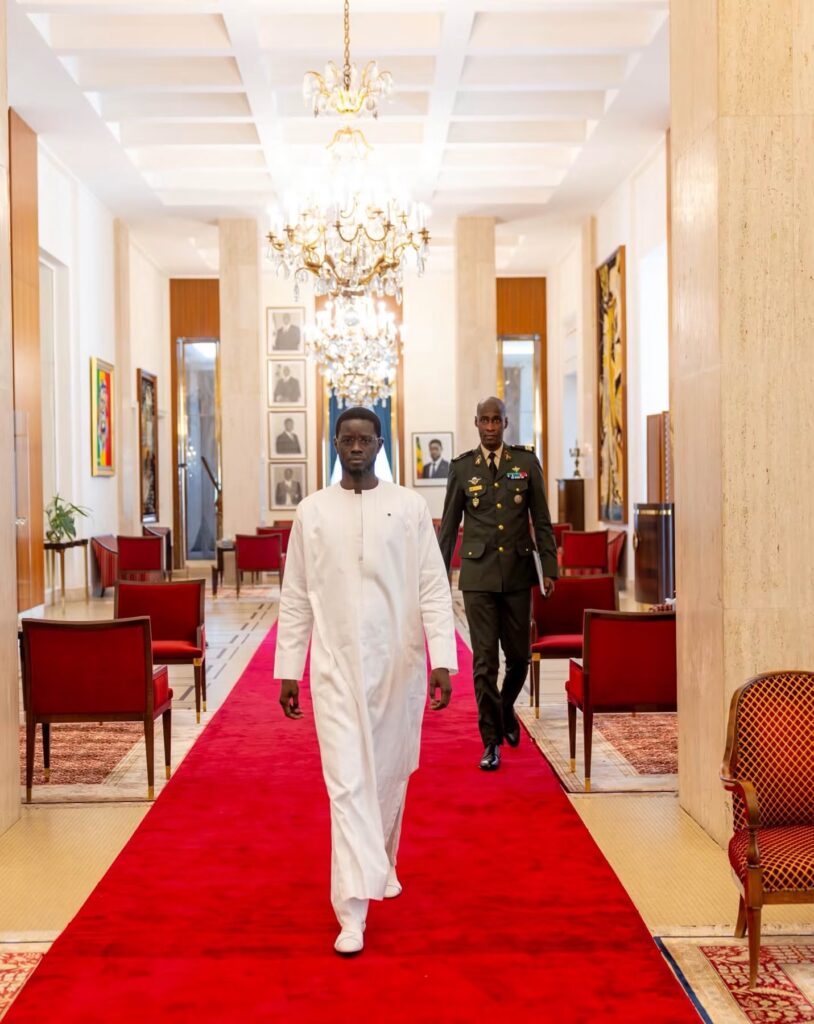
Photo: Presidency of the Republic of Senegal
Read also
 LFR 2026 rejetée par la majorité Pastef : analyse politique, budgétaire et institutionnelle des conséquences pour le SénégalBudget 2027 : le MEFP demande 1 019,4 milliards FCFA, en hausse de 42,4 %
 Budget 2027 : les députés rejettent en commission le projet du ministère des Télécommunications et du Numérique

Ne manquez aucune actualite tech et startup
Rejoignez notre chaine WhatsApp et abonnez-vous a SNL TV sur YouTube.
Rejoindre WhatsAppVoir SNL TV sur YouTube