🇬🇧 English | 🇫🇷 Français
Trained in management, the founder taught herself no-code tools to build a school guidance platform. Her application is not among the three finalists in the Start-up category of BAMA 2026, whose final will take place in Algiers on 6 December.
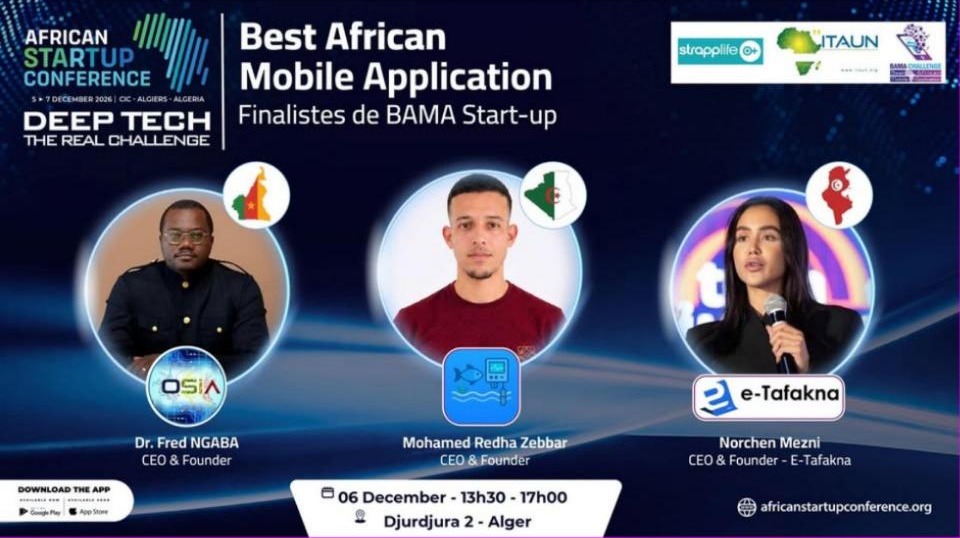
On 6 December, three start-ups will present their applications to the jury of the Best African Mobile Application (BAMA) 2026 final in Algiers: OSIA from Cameroon, AquaSensor from Algeria and E-Tafakna from Tunisia. LEERAL-edu is not among the finalists announced in the Start-up category. For its founder, Dior Ndiaye, preparing for the competition was nonetheless a step in structuring the project.
Organised by Algerian e-health start-up Strapplife and ITAUN, under the patronage of Algeria’s Ministry of the Knowledge Economy, Start-ups and Micro-enterprises, the competition will be held on the sidelines of the African Startup Conference 2026, from 5 to 7 December. The three Start-up finalists will present their applications on Sunday 6 December, from 1.30 pm to 5 pm, at the CIC in Algiers.
Shedding light on students’ choices
Founder and CTO of LEERAL-edu, Dior Ndiaye is studying management at the Institut Supérieur de Management (ISM) in Kaolack, alongside capacity-building programmes in entrepreneurship and digital transformation, notably with the African Union and ImpactHER.
The idea for the platform came from an observation: many baccalaureate holders choose their path without reliable information on schools, programmes and the jobs they lead to. Dior Ndiaye also points to young people’s limited access, particularly for girls, to science and technology streams, while local companies are looking for digital skills.
The project’s name sums up its ambition. “Leeral means ‘to shed light’ in Wolof. I created LEERAL-edu to put an end to this blind guidance,” she explains.
The platform brings together information on accredited schools and programmes, baccalaureate exam papers sorted by stream, and career profiles, particularly in STEAM fields — science, technology, engineering, arts and mathematics. The aim is to help students better understand the possible paths and the jobs they can lead to. Access is free for students and families.
Learning to build her product
Dior Ndiaye first listed and organised the information useful to students, before looking for ways to make it available on mobile phones. To build her prototype, she turned to no-code tools: Airtable to structure the database and Softr to design the interface and features.
“I learned everything on my own, by exploring the no-code ecosystem,” she says.
At first, she had to design the product architecture alone, work within the limits of free tools and handle administrative procedures and applications at the same time.
“I wondered whether a woman who is not a developer, starting out alone on her computer, would be taken seriously next to teams of engineers,” she confides. Her conviction that the project could be useful to young people helped her overcome her doubts.
Today, she describes her role as CTO as being responsible for the technical architecture and the product: modelling the databases, developing features and preparing the next technological steps. As founder, she also carries the project’s vision, its business model and partnerships with schools and companies.
BAMA, a structuring step
Preparing for BAMA 2026 led her to present a testable application, strengthen her application file and sharpen her pitch. She believes the experience moved her from a project approach to a start-up approach.
“BAMA 2026 was a real maturity accelerator,” she says. The preparation also allowed her to build a team around LEERAL-edu, with the support of her brother.
In the Start-up category, the three finalist applications are OSIA, an AI-based school guidance solution presented by Dr Fred Ngaba of Cameroon; AquaSensor, presented by Mohamed Redha Zebbar of Algeria; and E-Tafakna, presented by Norchene Mezni of Tunisia. The projects will be presented to the jury at the final in Algiers.
Time for pilots
From January 2027, Dior Ndiaye intends to focus on launching a free one-year pilot in Senegal with a first group of accredited schools and partner companies.
This phase is meant to check whether secondary school students use the platform regularly, whether virtual open days meet schools’ needs and whether companies see value in sponsoring study streams. The team then wants to assess the service’s impact, refine its business model and prepare a possible roll-out in other West African countries.
To young women who hesitate to get started because they cannot code, Dior Ndiaye offers advice drawn from her own experience: “Don’t wait until you know how to code to start solving a problem you care about. Start small, with what you have, test your idea and learn. Legitimacy comes from building.”
Ne manquez aucune actualite tech et startup
Rejoignez notre chaine WhatsApp et abonnez-vous a SNL TV sur YouTube.
Rejoindre WhatsAppVoir SNL TV sur YouTube